Wednesday, January 30, 2013

A Job for the I.C.


After finishing another line edit of my 401-page novel manuscript, I emailed a friend to share the sense of celebration. I’ve lost count of how many times I’ve reread and edited that manuscript, and she’s heard me celebrate every time. She’s listened to years of struggle and hard work on this novel, so it’s no wonder that her reply had a certain amount of wonderment. “I can't get over the patience and discipline you have to have throughout this process!  Yikes.  How are you able to do this with fresh eyes???” It was a very good question, and it made me realize something important about The Inner Critic.
            Whether I’m painting or writing, I inevitably come to moments in the creative process when I have to evaluate what I’m doing before I can go further. At those times, a serious artist has to be demanding. I’ve learned when a text needs to be improved. I know when I need to risk pushing an image or a surface beyond a comfort zone. I also know when I’m being lazy (if I’m honest with myself, I can hear a little voice in my head say, “I’m tired, that’s good enough”). To create a body of work I can feel proud of, I have to stand up to a level of scrutiny within myself that equals the keen eye of a real critic. That is the time when I put “the inner critic” to work.
            I’m not talking about unleashing the demeaning echo of someone from my past. The working inner critic needs to be an educated and honest evaluator. The Inner Critic I’m talking about has to be part of the  ‘higher self’. It is the voice that challenges me to raise the level of my work.
            Athletes exhibit that type of “inner critic” when they push themselves beyond past accomplishments. Often in sports, the coach plays the role of Inner Critic. In fact, a good coach can command a high salary because s/he has integrity and a reputation for being fair, tough, and knowledgeable. Even if s/he is harsh and pushy, it’s understood that their demands are for the good of the athlete and the team. The paradox of that role is this: The voice I’m talking about nags you out of a belief in your abilities, not out of a need to belittle or dissuade you.
So, how does an Inner Critic develop integrity? It will only have as much integrity as you give it. A good inner critic needs to be educated and cultivated. If you are a visual artist, study art history, attend gallery and museum exhibitions, and build a community of artists with whom you can develop a dialog about the work. If you’re a musician, listen to other musicians, attend concerts, and read a lot of music reviews. If you’re a writer, read a wide range of authors, write every day, and again, build a dialog in community with other writers. Attend classes and lectures. Read current critical thought in your field. It is every individual’s responsibility to educate the critic within. Only when you’ve done your homework, can you trust that inner voice.  
A constructive inner critic does not say “I like that” or “I don’t like that”. If that’s all you’re hearing, it is a voice of ignorance and judgment, and it’s probably someone’s non-productive voice from the past. Let your Inner Critic ask you questions. This is where my coach training and my work as an artist come together (for myself and for clients): both depend on asking good questions. A good question provokes thought, inspires risk-taking, and engages the dynamics of the creative process.
Success in the arts and in sports is the result of perseverance. Let your “inner critic” become an asset, and you’ll drown out all the foreign critics that slow you down.
           

Tuesday, January 22, 2013


Inauguration

As I watched the second inauguration ceremonies for President Obama, I thought about the significance of the ceremony. When a sitting president is re-elected, we don’t just say, ‘oh yeah, you can keep your job for another four years’. Instead, we go through enormous planning and cost to mark the ‘re-beginning’. The ritual of the second inauguration calls on the person in office to recommit, and restate the goals and intentions set for the next term.
         Those of you who have read my blog, or who’ve been my coaching clients, probably know where I’m going with this. Yes, I’m asking you what are you ready to recommit to in your life? You are stepping into your future, too. I know that you may have just set resolutions for the New Year (are you still holding to them?), but I am talking about your long term intentions in life.
Resolutions are often symptoms of intentions. If, for example, I say that I resolve to eat less saturated fats this year, my long term intention is to live a long and enjoyable life. I want to be energetic and optimistic for as long as I live, and I know that my health will be at the core of that optimism. So if you did make resolutions, look at them now in a new light. What does your resolution mean about your long-term intentions? What are you really committing to?
         Listening to the President’s speech I thought about the courage he exemplifies in making his intentions public. I know they are political agenda items and that he doesn’t carry them alone, nevertheless, when I thought of making such a declaration just for my own life, I got a queasy feeling in the pit of my stomach. That feeling made me realize the reason for a second inauguration, and the power of personal declaration. I also knew I wanted to blog about this, and yet that queasy feeling got worse when I thought about it. I didn’t want to look into the next four years and name the things I’m willing to fight for. I’m a progressive liberal, I said, I will support the President in his work toward more effective gun control, equal marriage under the law, women’s rights to control their bodies, and the necessary steps toward wise planetary decisions. Gee, that was easy. I didn’t get any feeling in my gut. So now, what will I commit to in my own life? And why should I tell anyone else about that commitment?
(Ah, the queasiness begins.)
         The question arises: What if I don’t do it? I could lose face. I could feel failure.
         Then I felt in my bones one of the most powerful aspects of coaching: accountability. In making that Inaugural speech, the President holds himself accountable to all of us, just as he did in the First Inaugural Address. And during the campaign people held him to his stated intentions. (You promised us jobs and I’m still out of work.) So that campaign was a time for him to acknowledge that he didn’t accomplish all his intended goals. But that didn’t stop him from committing again, and starting again. If he can do that on such a grand scale, I guess we can do it in the intimate corners of our life.
         So, it is my intention to re-commit myself to the dream of creating and supporting myself comfortably as a writer, artist, and life coach. I recognize that others may look at me and say, ‘of course’. But only I know what a hard decision that is. Only I know the fear of stretching money at the end of the month, or the vulnerability I endure by using a credit card to pay for supplies or marketing services. Only I know how much scarier it gets to still be struggling as age creeps up. But all that makes my declaration stronger and more powerful.
         Each of you who reads this will increase the strength of my inaugural declaration, so I thank you for that. If any one wants to write and make your declaration to me, I’ll be happy to receive it.

*The painting included above is titled "Launch". It was completed in 2010. Dimensions: 36" x 36"


Friday, December 7, 2012

Advent

I have always loved Advent calendars with their little doors and hidden images. If you are not familiar with them, they are put up during the month of December to count the four week leading up the birth of Christ. We have just begun Advent in the Christian sense, and it got me to thinking about what it means in regards to one's life. Pregnancy is an Advent season, for example. We go through other obvious Advents like waiting to move into a new house or apartment.
Advent is a time of anticipation and expectancy, it is also a time of preparation.
What are you anticipating? What are you preparing for? Or what could you be preparing for? What would be an exciting event for you to celebrate in the coming year?
I know it is customary not to start thinking of the new year until after the Christmas holiday, but then there is a lot of pressure to come up quickly with some clever or obvious declaration for a "resolution". What I am thinking about is not a resolution, but a new "thing". It could be a new attitude or an addition to your routine that is 'just worth a try.' A resolution suggests a commitments to something even before you know if you're going to want to keep it. So this season, think about the holidays as a period of Advent. What is dawning on your horizon, and how do you want to prepare for it? Happy Holidays!

Tuesday, October 9, 2012


Sisters of Clouds

October is a memorial marker for me, like a temporal headstone in the year. It's not because of All Souls' Day or Dia de los Muertos, it's because I always seem to lose loved ones in October. It is the month that took my  grandfather, then years later, my grandmother. It was also the month in which I lost  my father. So when I see its balloon-like O come up in the calendar, I take a deep breath and grit my teeth.
     The older I get the more loss I face. That's life, I guess. I know their is an adage that says 'time heals all wounds', that's a bit of a distortion if you ask me.  Time forces us to step forward unceasingly, well, until our own denouement. Most of us are pretty "scarred up" by the time we reach 50 or 60, but having survived our losses, we've also learned some essential lessons about life.
I've learned to use October as a time to give thanks for those I've lost. It's a time to remember the sound of their voices and special things they said to me. I remember the best things we shared and replay memories of them as clearly as possible.
I can't count how many wonderful memories I have of my grandparents. They taught me to speak Spanish from the time I learned to speak. They taught me about my ethnic identity and about our culture. It didn't matter to them that I was born in the U.S., except that it meant I didn't need to earn my American citizenship. Papa taught to appreciate the flamenco. Mama taught me about Spanish food. Abuelo taught me about orgullo: pride, and the importance of doing well in school. Abuelita, who died when I was seven, taught me that a woman could meet the demands of anything asked of her. My father, who did not believe in God, gave me a sense of the whole world as a mysterious and sacred phenomenon. Their legacy is an enormous part of who I am.
I've also been forced to face the loss of friends and colleagues. People my age. Somehow their passing brings death closer. Once the tears have subsided, I realize that the only thing to do is remember and give thanks for the time we had together. This year I give thanks for Peg and Karen, two redheads who never knew each other, but were always the life of the party. They had a way of surrendering to fun, that I always admired. And Ann, who read so many paperback books that they practically lined her walls like wallpaper. (We bought a memorial tile for her at the library.) I give thanks for Robert, who was as elegant a dancer as Fred Astaire and as sweet as a boy of six his whole life. It's still hard to put Felix among these memories, he just died on Labor Day. He was one of the most talented cartoonists I've ever known. And he proved to be as courageous as he was creative when his biting cartoons critical of the junta were published in a well-known Argentine political magazines during the Dirty War.
I remember my mentors with special gratitude. I was so fortunate to have been in the path of their very unique lives. Mary Caroline Richards was a poet, potter, and internationally known educator.  Though she lived well into her eighties, she always met the world with the wonder of a child, and the grace of an angel. Her books of poetry and her brilliant essays are still available. Sr. Jose Hobday, a firecracker of a nun, was half Irish Catholic and half Native American. She was outspoken and fun-loving, and most of all, wise. At the University of Creation Spirituality we displayed photos of her in a public dialog with the Dalai Lama.
The painting I've included with this post is called Sisters of Clouds. I painted it from an improvised meditation prayer that came to me some years ago with my friend Ann Hawthorne as she lay in Stanford Hospital in the final weeks of her life. My prayer took us into the sky where clouds change shape without pain or fear. We are just like clouds, I said, shape shifters, and sometimes we even disappear. But our nature to love and to remember never changes. Our humanity unites us and keeps us united. We age and we move on, yet we can see each other in the transparency of memories.  We are connected by the nature of our being, just like clouds. And from that prayer came the painting. Not long ago I saw a woman in a department store who looked so much like Ann, it was hard to believe that my friend had not come back to life. Then I thought about our prayer and about the painting. I smiled. She had come back to say hello, I thought. It didn't have to be her person, her spirit was certainly there, evoked by the resemblance of a stranger and the power of my memory.

I hope my reflections have inspired your own beautiful memories. You don't need to paint them, but spending time in the realm of remembrance can be a powerful meditation. In Mexico families gather at cemeteries on Dia de los Muertos. They bring the foods that were favored by the deceased, sing their favorite songs, and really celebrate their life. But we don't need to get that elaborate to appreciate our departed ones. A candle next to a photo, or a small vase with some flowers can suffice.
And this simple practice can introduce a profound dimension of gratitude to our daily life.


Friday, September 21, 2012

At a Loss for Words

This Human Life
It seems that no matter what we accomplish in our life, we seldom give ourselves the credit or praise we readily gift to others. It's been a while since I've posted here, my thinking being, 'Well, no one reads it anyway'. But thanks to the Blogger Stats, I see that over one hundred and fifty people read this blog last month, and while that's nothing by web standards, for me it's quite amazing. So thank you for reading, and if you'd like to drop me a note every now and then, it would be great to know something about you.
The painting to the left is one I have posted before, and it is the only one that's been requested to be re-posted. It's also one of the paintings now on view in the Addison Street Windows Gallery on Addison St. in Berkeley, California. It will be on view until November first. You can stop by any time, the windows are also lit at night. They are located between Milvia and Shattuck, next to the new venue for the performance space, Freight and Salvage, and across from the Berkeley Repertory Theater. I'm giving a little sidewalk reception on Sunday, Sept. 30th. Stop by and say hi.
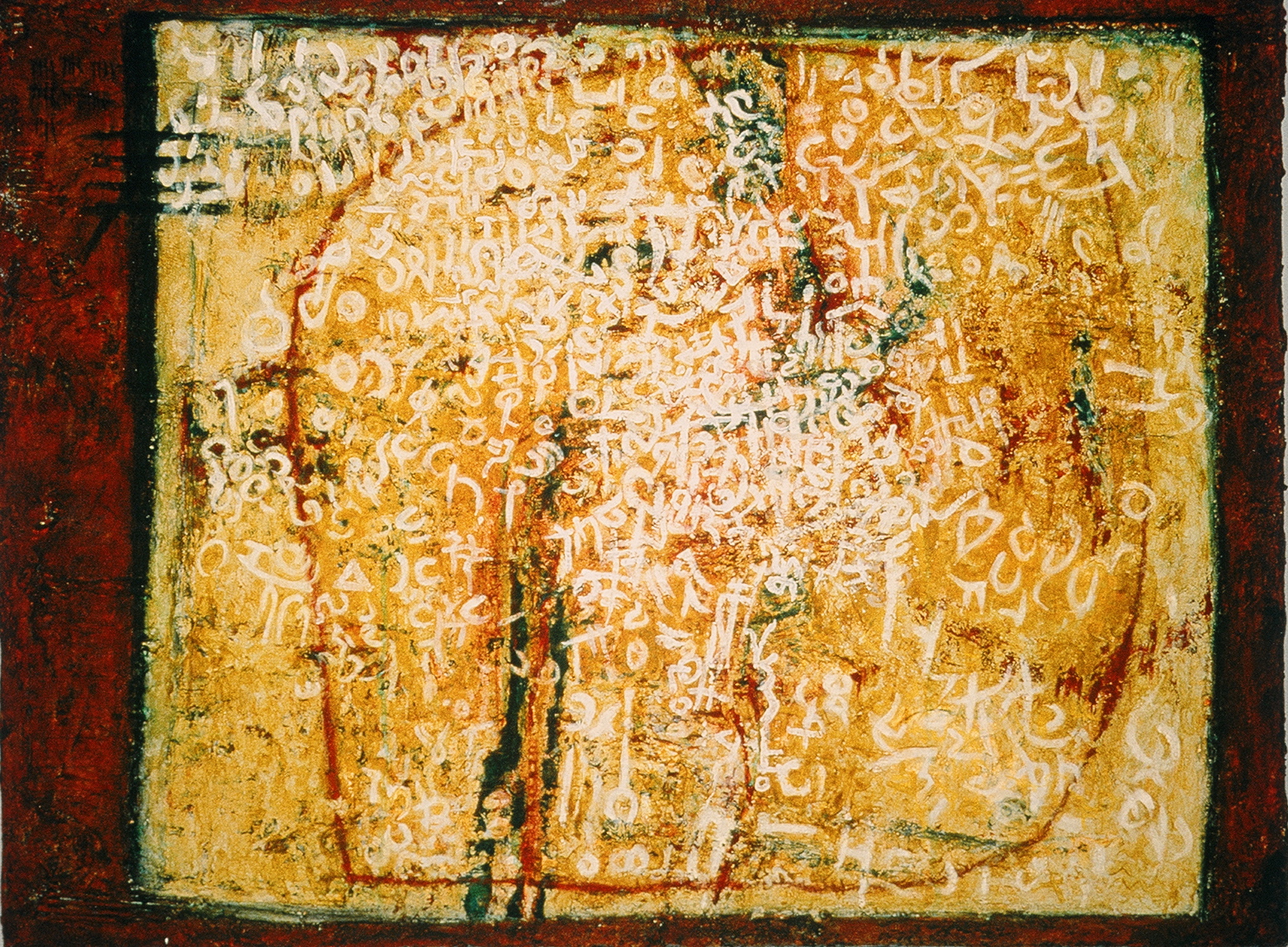
The title of the Addison Street Windows is Land and Language. The paintings on exhibit reflect the work I've been doing for about twenty years, following an impulse to mark and create paintings that move out of the body.  People seem to think that artists act from certainty, always knowing what we're doing and why we're doing it. Maybe some artists work that way, but for me the studio is the only place where I can lean into my intuition and act without reason.
Human experience is a mystery. Art reflects and celebrates that mystery.
Did you ever stop to realize how much of life is invisible? The illnesses that come at us, the emotions we feel, the thoughts we have: they are all invisible forces working through our lives. In a way, the marks that come into many of my paintings are the language of invisible forces. The earth holds, as if protecting, languages that are just as mysterious and undecipherable in it. They are the elaborate patterns of expression devised by humans before us, and they are literally part of the terrain of our world.
I hope my paintings and these thoughts are catalysts for your thoughts and your work. And again, thanks for reading.